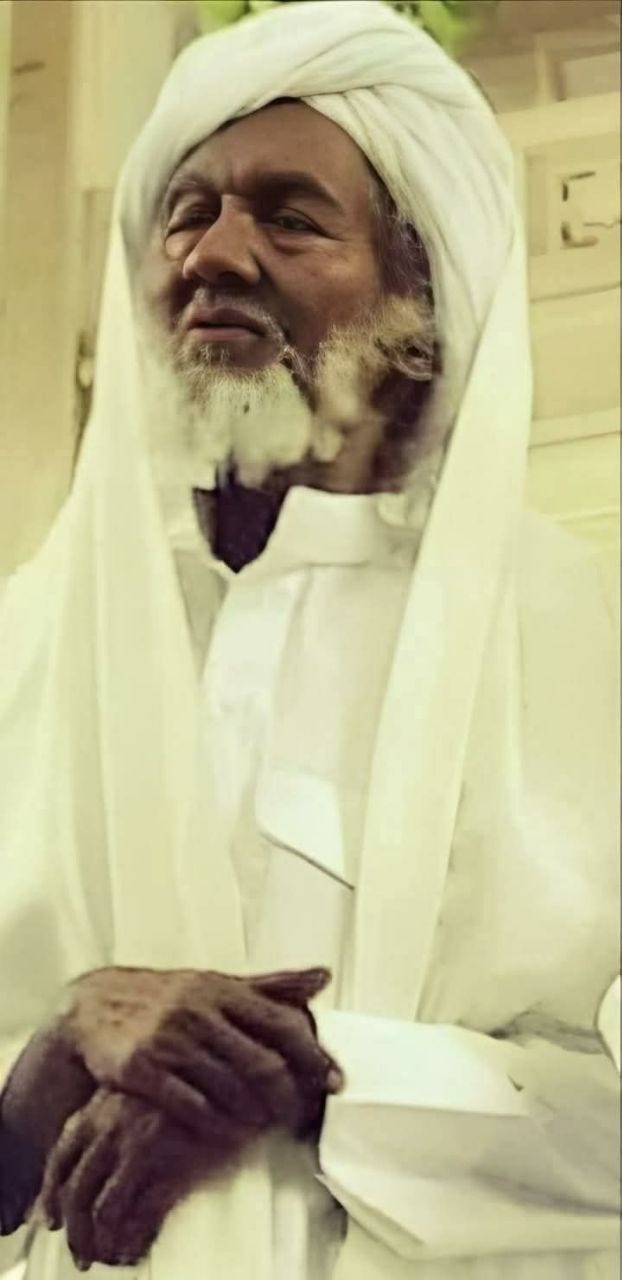
In the world of Islamic scholarship, some of the most profound teachers leave behind legacies that continue to illuminate hearts long after they've departed. Recently, I had the privilege of discovering one such luminary—a scholar whose works I wish I had encountered decades earlier.
A Scholar of Rare Depth
Shaykh Muhammad Amin Al-Harari was a master of multiple Islamic sciences: hadith, tafsir, Arabic grammar, and Shafi'i jurisprudence. Originally from the Horn of Africa region (Eritrea or Ethiopia), he spent several decades as a resident scholar in Makkah, where he dedicated his life to teaching and writing.
His scholarly output is nothing short of remarkable. His 32-volume tafsir of the Qur'an stands as a monument of detailed exegetical work, while his extensive commentaries on hadith demonstrate the depth of his engagement with the prophetic tradition. These are not superficial works—they reflect a lifetime of deep learning, careful analysis, and devotion to preserving and transmitting sacred knowledge.
A Regret and a Blessing
I must confess a deep regret: I only discovered Shaykh Muhammad Amin Al-Harari and came to appreciate his works after his passing. During my visits to Makkah, when he was still teaching there, I had no knowledge of him. The opportunity to sit in his presence, to benefit from his wisdom directly, to ask questions and receive guidance—that opportunity has passed.
Yet even in this regret lies a blessing. His works remain, and through them, he continues to teach. I recently acquired his magnificent 32-volume Qur'anic commentary, and it has become an invaluable companion in my own teaching. When I conduct lessons where we read through Qur'an translations, pausing for commentary and explanation, I find myself turning again and again to his insights.
A Dream
Recently, I came across a biographical note about Shaykh Muhammad Amin al-Harari that touched me deeply. It was an account shared on Facebook by an Algerian scholar, relating a dream that the Shaykh had experienced. What follows is that account narrated by the Algerian scholar:
Our teacher, the Great Scholar Muhammad al-Amin al-Harari al-Ethiopi (al-Habashi) al-Shafi’i al-Makki—may Allah have mercy on him—saw the Prophet ﷺ in his sleep while he was researching Sahih Muslim. He kept this vision a secret out of fear of fitna (tribulation) and vanity, but his son, Ridwan, shared it after his father's passing.
The Shaykh (may Allah have mercy on him) said:
"I was seized by intense pain one night from sciatica after I had written what I wrote concerning the Hadith of al-Miqdad. I went out to the Haram (in Makkah) and prayed the Dawn prayer there. When I returned home and had breakfast, I intended to write but was unable to do so because of the severity of the pain.
I lay down on my bed, overcome by great anxiety, fearing that death might overtake me before I could complete this book. I fell into a slumber and saw the Prophet ﷺ standing and delivering a sermon.
The earth was radiant with a light the likes of which I have never seen. We sat around him in a circle, everyone racing to take the spot closest to him ﷺ; most of those occupying the nearest spots were his Companions (may Allah be pleased with them). I sat in a narrow gap near him that was not large enough for sitting, but it became spacious for me due to my slim frame.
When everyone had taken their place in the circle, the Noble Prophet ﷺ said: 'Who among you wishes to study Hadith with me?' I stood up from the circle and said: 'I wish to study with you, O Beloved of Allah.' He said: 'Read, and I shall listen to you.'
I began reading this Hadith of al-Miqdad to him. I intended to ask him about the meaning of: 'the sun will be at a distance of a mile from them.' When I reached the middle of the Hadith, Abu Hurayrah stood up and said: 'We Arabs have more right to study with you, O Messenger of Allah. This is a Black non-Arab (A'jami) man; he is not suited to study with you because he makes grammatical mistakes in your speech.' The Messenger ﷺ and his Companions remained silent.
I said: 'You gained the companionship of the Messenger ﷺ, you were the narrator of his Hadith, and you gained the status of closeness to the Messenger ﷺ. As for me, I am a non-Arab man who was deprived of what you gained. Therefore, I have more right to study with him ﷺ, for I am a stranger/slave, lost in your lands, seeking from you the greatest prize and the inheritance of my brother Bilal ibn Rabah (may Allah be pleased with him).'
The Messenger ﷺ said to his Companions: 'This man has spoken the truth in his words, in what he seeks from us, and in his complaint of being a stranger. Leave him be, O Abu Hurayrah, let him read.'
Then the Messenger ﷺ looked at me and said: 'Read, O inheritor of my Mu'adhin (caller to prayer).'
So I read to him. When I reached the point that was confusing to me, I asked him. He said: 'Look at the sun; it will be like this on the Day of Resurrection.' I looked at it, and it was stationary while the clouds were moving above it—meaning, it was closer to the earth than the clouds.Then I woke up, and the anxiety and pain had left me. I returned to my writing, energetic and healthy.
To Allah belongs all praise and thanks for this immense blessing. This glad-tiding vision occurred to me on Sunday, at the time of Duha (forenoon), on the first day of the month of Rajab, 1428 AH."
May Allah Almighty have mercy on him with an expansive mercy and grant him dwelling in His spacious gardens.
Note: Our teacher, the Great Scholar, the Jurist, the Blessing, the Long-lived, Muhammad al-Amin al-Harari al-Shafi’i al-Makki (may Allah have mercy on him), was among the saints of Allah (Awliya). He was a man of miracles (karamat). May Allah Almighty have mercy on him.
May Allah have mercy on Shaykh Muhammad Amin al-Harari and elevate his rank. And may we benefit from the knowledge he left behind.